When a child explodes over something that seems tiny, it is tempting to focus on the final event: the wrong cup, a change of plan, being asked to put their shoes on. But the final trigger is often only the visible part of what has been building.
Simple metaphors can help adults — and children — make sense of that build-up. They give us a way to talk about big feelings without labelling a child as naughty, dramatic or overreacting. Here are four useful ways to think about anger and overwhelm.
1. The Shaken Fizzy Bottle
Imagine shaking a bottle of fizzy drink. One shake may not seem like much. Neither may the next. But the pressure inside keeps building until, eventually, the lid comes off.
For a child, the “shakes” might be tiredness, hunger, worries, noise, disappointment, unexpected changes, friendship problems or simply having too much to do. The explosion happens now, but the shaking may have started hours earlier.
A more useful question than “Why are you behaving like this?” can be: “What has been shaking your bottle today?”

2. The Volcano
A volcano does not begin with the eruption. Pressure has been building beneath the surface long before we see lava.
Children can be similar. We see the crying, shouting, refusal or meltdown, but underneath may be tiredness, sensory overload, anxiety, disappointment, loneliness or a need for reassurance. Looking beneath the surface does not mean ignoring unacceptable behaviour. It helps us understand what needs addressing as well as what needs correcting.

3. The Overflowing Cup
Everyday difficulties can be thought of as drops filling a cup. Most days, children have enough capacity to manage them. On a difficult day, however, the cup may already be close to the top.
Then one apparently tiny event causes the overflow. It is easy to conclude that the child has had an enormous reaction to a very small problem. In reality, we may simply be seeing the final drop.
Instead of thinking, “You’re overreacting,” it can help to wonder: “Your cup must have been very full today. What has been filling it?”

4. The Storm Dragon
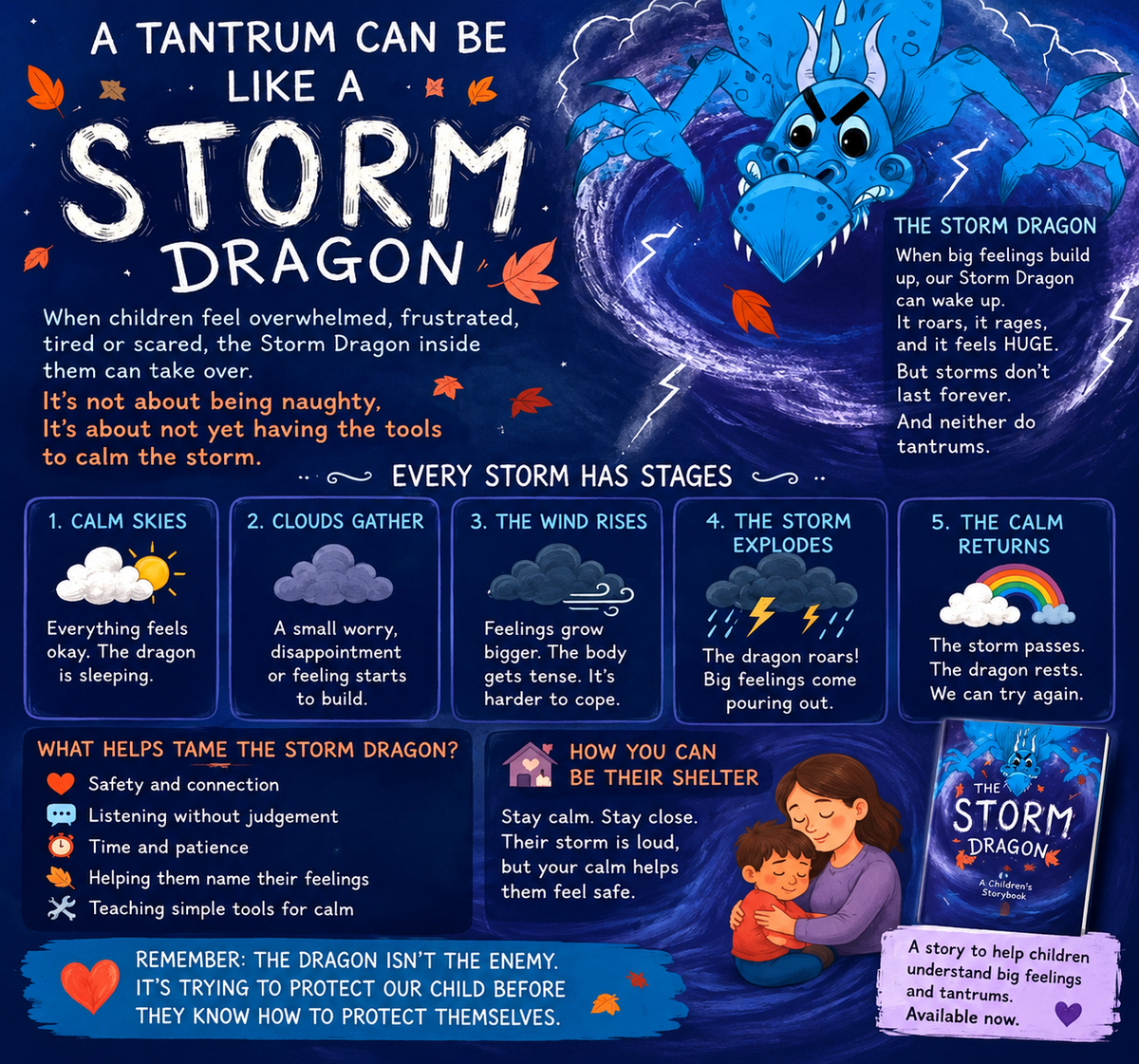
In The Storm Dragon, big feelings are imagined as a storm that grows inside a dragon. The sky is not instantly wild: clouds gather, the wind rises and only then does the storm explode. Afterwards, the calm returns.
This can be particularly useful for children because it separates the feeling from their identity. They are not “a bad child”. They are a child experiencing a storm — and storms pass. Over time, children can learn to notice their own early warning signs and practise ways to calm before the storm becomes overwhelming.

The Metaphor Isn’t the Important Part
Some children will connect with a volcano. Others will immediately understand a fizzy bottle, an overflowing cup or a storm. The useful part is not choosing the “right” metaphor. It is helping a child recognise that feelings build, that there are often warning signs, and that there are things we can do before they become overwhelming.
Understanding the reason for a behaviour is not the same as excusing it. Children can still learn boundaries, repair harm and take responsibility. But regulation is a skill, and skills have to be taught. When adults become curious about what happened before the explosion, we are in a much better position to help children learn what to do next time.
Helping Children Calm and Talk
When a child is dysregulated, calm connection usually needs to come before a long conversation. Once the storm has passed, gentle questions can help them identify what they were feeling and what had been building.


If your child enjoys learning through stories, you can discover The Storm Dragon or explore the free Resource Library for activities and ideas to use at home or in the classroom.